
-
All-on-4 Dental Implants: How Full-Arch Tooth Replacement Works
Losing most or all of your teeth can affect more than your smile. Missing teeth may make chewing difficult, change the way you speak, and affect confidence in everyday situations. For people who need to replace an entire row of teeth, All-on-4 dental implants can be one treatment option worth discussing with a qualified dentist.
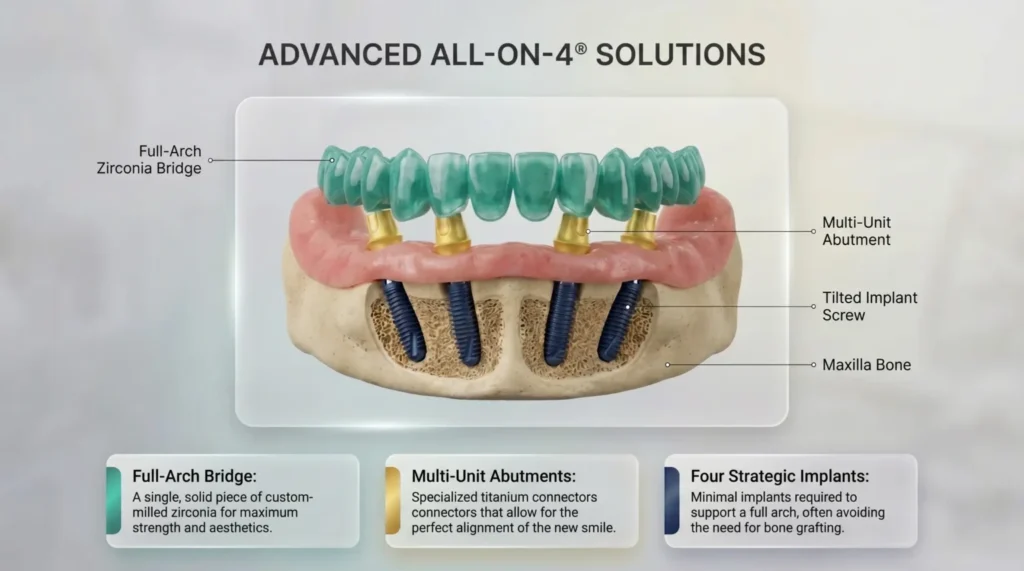
All-on-4 is a full-arch restoration technique that uses four strategically positioned dental implants to support a fixed set of replacement teeth. Instead of placing an individual implant for every missing tooth, the dentist uses a carefully planned arrangement of implants to support a bridge across the arch.
How does the All-on-4 procedure work?
Treatment begins with a detailed dental examination. The dentist assesses the gums, remaining teeth, jawbone, bite, and general oral health. Three-dimensional imaging, such as a CBCT scan, may be used to evaluate bone volume and identify important anatomical structures.
Based on these findings, the dentist develops an individual treatment plan. If severely damaged or non-restorable teeth remain, extractions may be necessary. The four implants are then placed in planned positions to provide support for the future restoration.
In selected cases, patients may receive a temporary fixed set of teeth on the day of surgery or shortly afterwards. However, immediate loading is not suitable for everyone. It depends on factors such as implant stability, bone quality, and the patient’s clinical condition. The final bridge is generally fitted after the appropriate healing period.
Who may be suitable for All-on-4 implants?
This treatment may be considered by people who have lost most of their teeth, have several teeth that cannot be saved, or currently use dentures and want to explore a fixed alternative.
Suitability cannot be determined by age or appearance alone. Gum disease, uncontrolled medical conditions, smoking, bone loss, and certain bite problems may affect treatment planning and healing. Some patients may need additional procedures, while others may be better suited to a different implant approach or a removable restoration.
A consultation is essential to establish whether All-on-4 is appropriate for the upper jaw, lower jaw, or both.
What are the potential benefits?
One potential advantage is that four implants can support a complete arch of replacement teeth, reducing the number of implants needed compared with replacing every tooth individually. A fixed restoration may also provide a different experience from a removable denture, particularly in terms of stability during everyday activities.
Another benefit is that treatment can sometimes be planned to make use of available bone and reduce the need for grafting. This is not guaranteed, as the amount and location of bone loss vary from patient to patient.
Patients should also understand the limitations. Implant surgery requires healing, the temporary and final teeth may differ, and the restoration needs regular maintenance. Implants do not eliminate the need for professional dental care.
What should you know about recovery and long-term care?
Some swelling, bruising, tenderness, and dietary restrictions are common after implant surgery. The dentist will provide instructions for cleaning the mouth, managing discomfort, and choosing suitable foods during the initial healing period.
Follow-up appointments are important for monitoring healing and checking the fit of the restoration. Once the permanent bridge is in place, patients need to clean carefully around the implants and beneath the prosthesis using the recommended brushes or other cleaning aids. Professional maintenance is also necessary to help detect problems early.
The long-term success of treatment depends on several factors, including planning, implant stability, oral hygiene, general health, and regular follow-up.
Considering All-on-4 treatment in Albania
Albania has become an option for international patients researching dental implant treatment, partly because some clinics offer lower prices than providers in parts of Western Europe. However, the cheapest quote is not necessarily the best choice.
Before committing, ask for an itemized treatment plan that explains the implant system, temporary and final restorations, extractions, possible bone grafting, diagnostic scans, and follow-up arrangements. If you are travelling from abroad, confirm how many visits may be needed and how complications will be managed after you return home.
It is also worth asking who will perform the surgery, what materials will be used for the final bridge, and what maintenance the restoration will require over time.
All-on-4 can be a useful solution for appropriately selected patients, but it is not the only option for full-arch tooth replacement. A personalized assessment helps determine which approach offers the most suitable balance of function, comfort, cost, and long-term care.
For a more detailed overview of the procedure, treatment planning, and options available in Albania, this page may be a helpful starting point: https://andent.al/all-on-4-dental-implants-albania/
andent.al
All-on-4 Dental Implants in Albania from €3,200
Replace a full arch with All on 4 dental implants in Albania at Andent Clinic Tirana, with expert planning and fixed smile results.
Sorry, there were no replies found.
Log in to reply.